Last winter, a homeowner heard something no one wants to hear: water running into their finished basement. They couldn't tell where it was coming from, so they called for help. A licensed plumber was dispatched immediately. Still, the basement had completely flooded before the water was turned off.
The culprit? A garden hose hooked up to the outdoor faucet. Water trapped inside the faucet froze, so the faucet burst and sent water pouring into the basement. The carpet was ruined, and the soaked drywall had to be cut out so the wall cavities could dry, in an effort to lower the risk of mold.
The most frustrating part? A few minutes of winter prep could have prevented thousands of dollars in damage. This article offers four simple steps to keep this from happening to your home.
Why do outdoor faucets burst?
An outdoor faucet is the most exposed part of your plumbing. It sits on the outside wall, where it takes the full force of winter. Water expands as it freezes. When ice forms in the faucet or the pipe behind it, it squeezes the water still trapped there. Pressure builds until the faucet or pipe splits.
Two common mistakes leave water trapped there. First, a hose left connected holds water in the faucet and keeps it from draining, and that is true of frost-free faucets too. Second, an indoor shutoff valve left open on a standard faucet keeps the pipe leading to the faucet full all winter.
Either way, the split often happens inside the wall, where you can't see it. It may not leak until the ice thaws or you turn the faucet on again. That's when the water finally runs into your walls and basement.
How much a burst costs depends on where it happens. Best case, the break is in the faucet itself, and the faucet just needs to be replaced. Worst case, the pipe splits inside the wall, and the repair also means opening the wall and replacing the pipe. Plumbing repairs can run from $375 to $1,200, depending on where the break is and how difficult it is to reach. Water damage is a separate cost that can reach into the thousands.
Winterize an outdoor faucet in four steps
The good news is that you can winterize your outdoor faucet in just a few minutes. Take the first three steps now, and you won't have to think about that faucet again until spring. Already had a freeze? Do it today anyway.
Step #1: Disconnect your hose and every attachment.
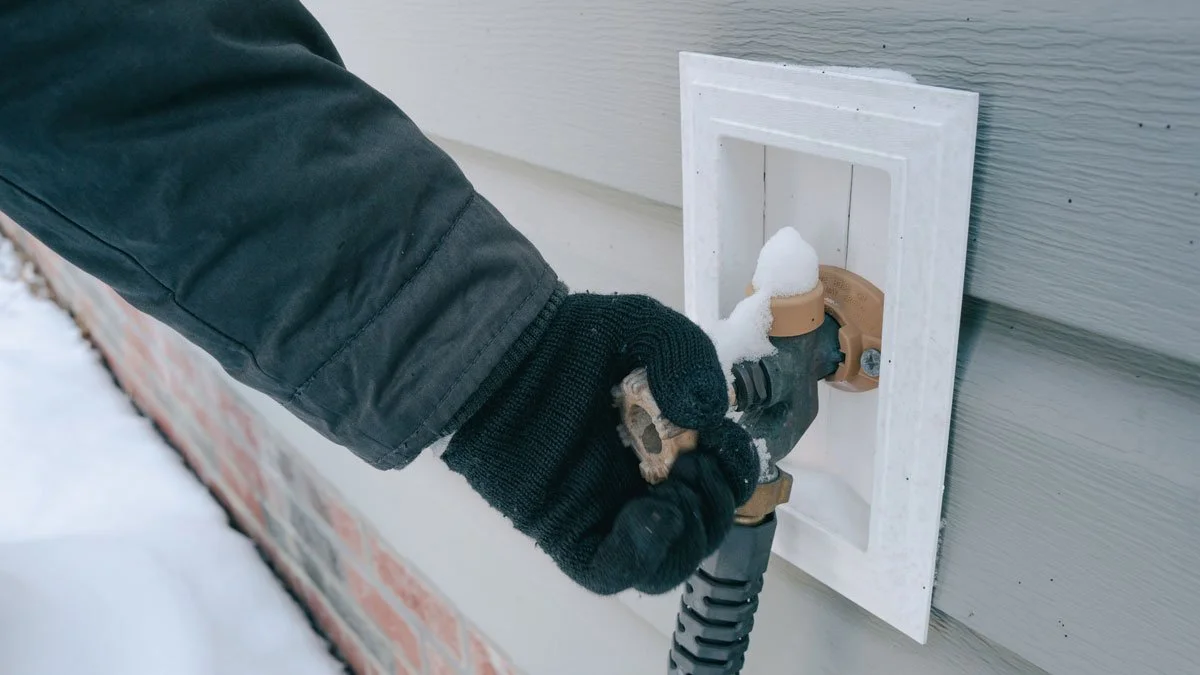
Remove hoses, splitters, and quick-connect fittings from every outdoor faucet, including frost-free models. Each attachment can trap water and keep the faucet from draining.
Not sure which faucet you have? A frost-free faucet's handle usually points straight out from the wall. A standard faucet's handle usually sits at an angle.
Step #2: Drain your standard faucet.
Find the indoor shutoff valve that feeds the faucet, usually in the basement where the pipe passes through the outside wall, and close it. If the valve will not turn by hand, stop and call a licensed plumber. A forced valve can snap at the stem or crack at the body. Then only your home's main shutoff will stop the water. If the valve closes, open the outdoor faucet to drain the line. If the shutoff has a small drain cap, set a bucket underneath and open the cap to let the rest of the water out. Put the cap back on and leave the outdoor faucet open for the winter.
Step #3: Let your frost-free faucet drain.
Remove the attachments, turn the faucet off, and let it drain. It needs a slight downward slope toward the outside so the water can run out.
Step #4: Check for leaks next spring.
The first time you turn the faucet on next spring, check inside the house, on the other side of the wall from the faucet. Look for drips or a damp spot. A freeze crack can go unnoticed all winter and only leak once you use the faucet again. Our article on hidden leaks explains where else to look.
When should you call a master plumber?
You do not need to call a plumber as long as the indoor shutoff is easy to reach and works properly, and you are able to disconnect and drain your faucet on your own.
Call a master plumber if:
Your standard faucet has no indoor shutoff valve, or the valve will not turn by hand
Your frost-free faucet holds water. A healthy one lets out a short trickle each time you shut it off
Water leaks inside the house when the outdoor faucet is on
A licensed plumber can install or replace the shutoff valve so the line can be drained. If the faucet or pipe is already damaged, the plumber can repair or replace the outdoor faucet, known in the trade as a hose bib, and fix the frozen or burst pipe.
Plumbing experience when it counts
The homeowner with the flooded basement called Suburban Plumbing Services. Jim, the owner and a master plumber, responded to the call. Once he located the source, Jim shut off the home's main water supply and capped the line serving the damaged faucet to isolate the leak.
He photographed the damage and helped the homeowner by immediately calling in a restoration company he trusts to start drying out the basement. Jim provided a plumbing repair quote and worked with the homeowner's insurance adjuster. When the claim was approved, Suburban returned and finished the plumbing repairs.
A burst pipe rarely happens at a convenient hour. Suburban Plumbing Services responds day and night, so an after-hours call reaches a real person.
This flood did not have to happen. A garden hose disconnected before the first freeze would have saved the homeowner precious time and money.
One lesson from that basement: know where your main water shutoff is. A closed main stops the water while help is on the way.
Your next step
Do you have a shutoff valve that won't turn or a faucet that won't drain? Schedule service on our website or call 586-215-1721. We'll respond the same day and give you an exact price before any work starts. No guessing. No surprises.
Consider having a licensed plumber check your home annually for potential problems. Become a Suburban Plumbing Services Peace of Mind Protection Plan member for just $180 a year. We'll do a whole-home inspection and provide a detailed written report, so a shutoff valve that is starting to stick gets found before it becomes an emergency.